Add Whimsy to Your Designs with Happy Hatchling
Understanding the Personality of Happy Hatchling
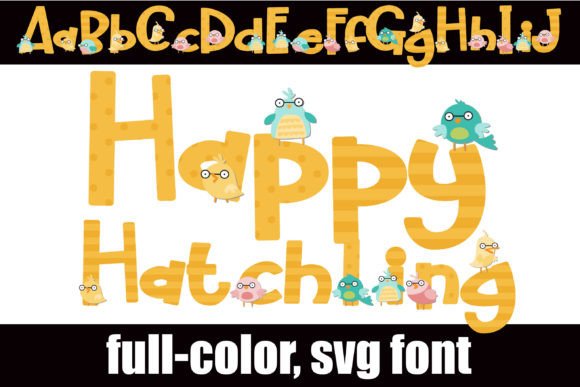
When you first encounter the Happy Hatchling typeface, you immediately notice it doesn't try to be serious or overly corporate. It is a premium font that leans heavily into joy and playfulness. As a display font, its primary goal is to grab attention through shape and color rather than subtlety. The visual characteristics are distinct: each letterform is constructed with rounded, organic shapes that mimic the softness of new life, paired with a bold palette of bright, cheerful colors. It isn't just a standard black-and-white typeface; it is a creative font that brings its own color scheme to the party.
The personality of this typeface is undeniably quirky. It avoids the rigid geometry of a standard sans serif font or the traditional structure of a serif font. Instead, it occupies a unique space between illustration and typography. Because it is PUA encoded, you have access to a full set of delightful glyphs and swashes. This encoding is a technical detail that offers practical freedom; it means you can access special characters and alternates in any standard design software without needing advanced OpenType features. This makes adding a flourish to a capital letter or a tail to a lowercase 'y' incredibly effortless.
Where This Font Fits Best: Practical Applications
Choosing the right tool for the job is fundamental to good design. Happy Hatchling is not the font you use for the body text of a legal contract or a technical manual. It is a display font, meaning it shines brightest in short bursts—headlines, logos, and call-to-action buttons. Its visual density and playful nature make it perfect for specific niches across web design, print, and digital media.
Branding and Logo Design
For entrepreneurs and small business owners, a brand identity needs to be memorable. If your brand caters to children, families, education, or whimsical food products (like a bakery or ice cream shop), this font sets the tone immediately. Using Happy Hatchling in your logo design communicates approachability and fun. It tells your audience that your business doesn't take itself too seriously and prioritizes a positive customer experience.
Publishing and Editorial Design
In editorial design, hierarchy is everything. You need a headline that pulls the reader into the story. Happy Hatchling works exceptionally well for magazine covers, blog post headers, or chapter titles in children’s books. It provides a stark, engaging contrast to a clean body copy font. Because it is so distinct, it helps break up the visual monotony of a text-heavy page, making the content feel more accessible.
Digital Presence and Social Media
The digital landscape is crowded. On platforms like Instagram or Pinterest, you have milliseconds to stop a user from scrolling. Social media graphics utilizing Happy Hatchling benefit from its bright colors and high energy. It is excellent for announcements, sale graphics, or headers on a YouTube channel. For web design, it should be used sparingly—perhaps in a hero section or a specific banner—to add personality without affecting the site's load time or overall readability.
The Strategic Impact on Visual Hierarchy and Engagement
A font choice is rarely just about aesthetics; it is a strategic decision that influences how information is processed. Happy Hatchling impacts visual hierarchy by naturally drawing the eye. Because of its bold palette and unique shapes, it commands the top of the hierarchy. This forces the viewer to read the most important message first.
However, this intensity requires careful handling regarding readability. A complex, colorful display font can become difficult to decipher if used at small sizes or for long sentences. To maintain professionalism, pair it wisely. A great font pairing strategy is to combine Happy Hatchling with a neutral, geometric sans serif font for subheadings or body text. This allows the display font to be the "star" while the supporting text does the heavy lifting of conveying detailed information.
Furthermore, the use of color within the font files means you need to consider your background. High contrast is essential. Placing these colorful letters on a very busy background can create visual noise, whereas a clean, solid background allows the modern typography style to pop. This attention to contrast directly influences audience engagement; if the text is easy to see and feels joyful to read, users are more likely to interact with the content.
A Guide to Selecting and Using Happy Hatchling
Integrating a new asset into your workflow requires a bit of planning. If you are considering adding Happy Hatchling to your library of design assets, here is how to evaluate it and use it effectively.
Evaluating Project Fit
Before downloading, look at the scope of your project. Are you working on packaging design for a gourmet product aimed at corporate executives? This is likely not the right fit. Are you designing flyers for a community fair, a header for a parenting blog, or branding for a toy store? That is the sweet spot. The font is versatile within its niche, but it is not a "one-size-fits-all" solution. Treat it as a specialty ingredient rather than the main course.
Testing and Pairing
When you test the font, don't just type "The quick brown fox." Type out your actual headlines. See how the specific letter combinations in your project interact. Because the font includes swashes and glyphs, experiment with them. A swash on a capital letter might work for a logo but look cluttered in a sub-headline.
Regarding pairings, look for contrast in structure and weight. Since Happy Hatchling is round and playful, a handwritten font might be too chaotic when paired with it. Instead, look for a sturdy sans serif or even a clean script font that has a more formal flow. The goal is to create a balance between the energy of the headline and the stability of the body text.
Licensing and Technical Details
Finally, ensure you understand the licensing. Since this is a commercial font, verify that the license covers your specific usage—whether that is for a client's logo, a print-on-demand product, or a website. As mentioned, the PUA encoding is a significant technical advantage. It ensures that even if you aren't an expert in font features, you can still copy and paste the special swashes from a character map into your document. This makes the creative font accessible to hobbyists and professionals alike, ensuring that your final design looks exactly as intended.